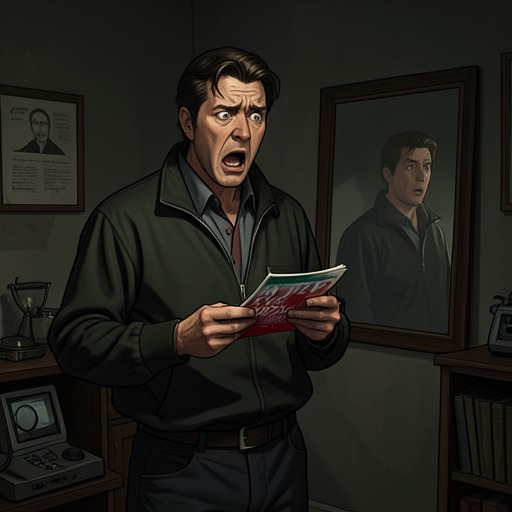
Christian Vance
After Ever HappyChristian Vance is Hardin Scott’s biological father, a fact hidden within the Scott family’s history and revealed only after years of Christian’s attempts to stay near Hardin without openly taking a father’s role. His past with Trish and Ken Scott explains the secret; his later efforts to support Hardin, accept responsibility, and wait for reconciliation show what that secret costs in the present.
Identity and Background
Christian grew up with Ken, describing them as friends for as long as he could remember. His bond with Ken was later compromised by his love for Trish, Ken’s partner and Hardin’s mother. Christian recalls Trish as an escape from his own self-destructive behavior, but his attachment to her did not make him stable or dependable. When she became pregnant, he imagined that she would leave Ken, marry him, and allow him to be present for the child. He promised that if she chose him, he would stop wasting his life and be there for both her and the baby.
Trish did not believe Christian was stable enough to build a life with. He remained silent as she and Ken announced that they were expecting a child and would marry that same week. The disclosure makes Hardin’s birth part of a painful triangle: Christian wanted to be his father, but did not become the man Trish trusted to raise him. The biological truth later becomes difficult to square with the family relationships already formed around Hardin.
The Secret and Its Disclosure
Kimberly confirms the truth to Tessa: Hardin is Christian’s son. Tessa recalls that she once assumed Ken was Hardin’s father because Ken’s dark hair and height seemed to resemble Hardin. Kimberly sees a different likeness, pointing to the shared eye color and facial structure between Christian and Hardin. Their contrasting impressions underscore how the secret could remain hidden even when resemblance offered clues: people interpreted Hardin’s appearance through the family role they already believed.
Christian explains the history to Hardin during a car ride, first asking him to keep an open mind. Hardin bristles at being addressed as if he were a child, and Christian begins by describing his lifelong friendship with Ken and his love for Trish. He acknowledges that he expected Trish to choose him when she became pregnant, and that she instead married Ken. The explanation gives Hardin the circumstances behind his parentage, but does not soften the immediate injury of learning that Christian and others had withheld it.
When Hardin accuses Christian of lying throughout his life, Christian does not contest the accusation. He says that after Hardin moved to America, he hoped to grow close to him without acting as a father figure. Christian stayed in contact with Trish, hired Hardin at Vance Publishing, and tried to approach him only as closely as Hardin would allow. He also repaired his relationship with Ken, though he acknowledges that hostility remained between them. Christian believes Ken pitied him after the death of his wife and had changed by then; his own stated aim was simply to have whatever closeness Hardin would accept. He recognizes that Hardin may hate him, while hoping that he had managed to be close to him for a time.
Fatherhood and Family Ties
Christian’s account of fatherhood is shaped by more than his relationship with Hardin. After his wife died, he regarded Smith as a second chance to be a father and says the boy helped make him feel whole again. He saw a resemblance between Smith and Hardin as a child, though with lighter hair and eyes. That comparison links his two experiences of fatherhood: the son he lost the chance to raise and the child he later helped care for.
The disclosure also places Christian’s past inside Ken’s present family life. At Richard Young’s funeral, Tessa worries that Hardin, distressed and feeling bad, might reveal Christian’s paternity to Ken in front of everyone. She hopes Hardin will wait until he can choose a more appropriate moment, and insists to herself that he is decent even though she believes he is bad for her. Christian’s secret is therefore not simply private history between father and son; its revelation threatens to reopen the old damage between Christian and Ken, while affecting the people gathered around them.
Intervention and Accountability
Christian’s concern for Hardin becomes immediate when he rushes into a liquor-strewn living room and finds Hardin holding a lighter. He has heard sirens on the way and urges Hardin and Tessa to leave at once. Hardin realizes that Tessa called Christian, making the intervention another sign that Christian has become someone the people around Hardin can summon in a crisis. Soon afterward, Tessa tells Hardin that Christian is alive but has been burned on one leg and is expected to be arrested when released from the hospital.
The later account clarifies the extent of the injury and its consequences. The fire mostly caught Christian’s clothes rather than his skin, and his leg is healing. He fabricates a story that a group of punks broke into and vandalized the house before setting it on fire; the incident is treated as an arson case without leads. The injury is visible later when Christian enters the kitchen in a wheelchair. Kimberly reassures Tessa that he will be fine, while the scene makes his physical vulnerability part of the aftermath of the fire without resolving every consequence of his actions.
Relationships and an Unfinished Repair
Christian’s relationship with Kimberly is presented as affectionate and increasingly secure. He enters while she and Tessa are talking, and she explains his condition and assures Tessa that he will recover. Christian smiles at his fiancée, kisses her tenderly, and leaves them to their conversation. Tessa is surprised by how happy Kimberly appears with him: she knew Kimberly was forgiving Christian, but had not understood how settled that forgiveness had become. Their engagement thus offers a counterpoint to Christian’s unresolved relationship with Hardin; repair is possible in one bond while another remains provisional.
Christian does not demand immediate reconciliation from Hardin. When Tessa defends Hardin as someone with a great deal going on, Christian accepts the criticism, says that he deserves it, and acknowledges that Hardin is dealing with much. He wants to speak with him but says he will come around when ready. Later, Hardin angrily confronts Christian for failing to answer his phone after Hardin drove all the way to see him. Christian apologizes, explaining that he and Kimberly had been downtown and his phone had no service; he invokes the unpredictability of plans rather than dismissing Hardin’s frustration. Their exchange shows that patience has not erased conflict: Hardin still expects Christian to answer, and Christian still has to face the consequences of being unreachable.
Narrative Role and Significance
Christian’s story turns on the difference between biological fatherhood and earned closeness. He is Hardin’s biological father, but his early instability, Trish’s decision, and the concealment of the truth mean that biology does not automatically grant him the place he wanted. His later employment of Hardin, contact with Trish, and efforts to approach Hardin on his terms are acts of attempted connection, not proof that the earlier betrayal has been repaired.
The character also links several family histories of secrecy, regret, and recovery. His lost chance with Trish damaged his friendship with Ken; his concealed paternity complicates Hardin’s understanding of both men; and his desire to be a father appears again in his bond with Smith. The book allows Christian to admit fault and to care for Hardin without converting either admission into a guaranteed reconciliation. His defining movement is from an imagined claim on fatherhood to a more limited offer of presence, one that Hardin may accept or refuse.